Transactions are happening. It’s the “wait-and-see” people who are missing out.

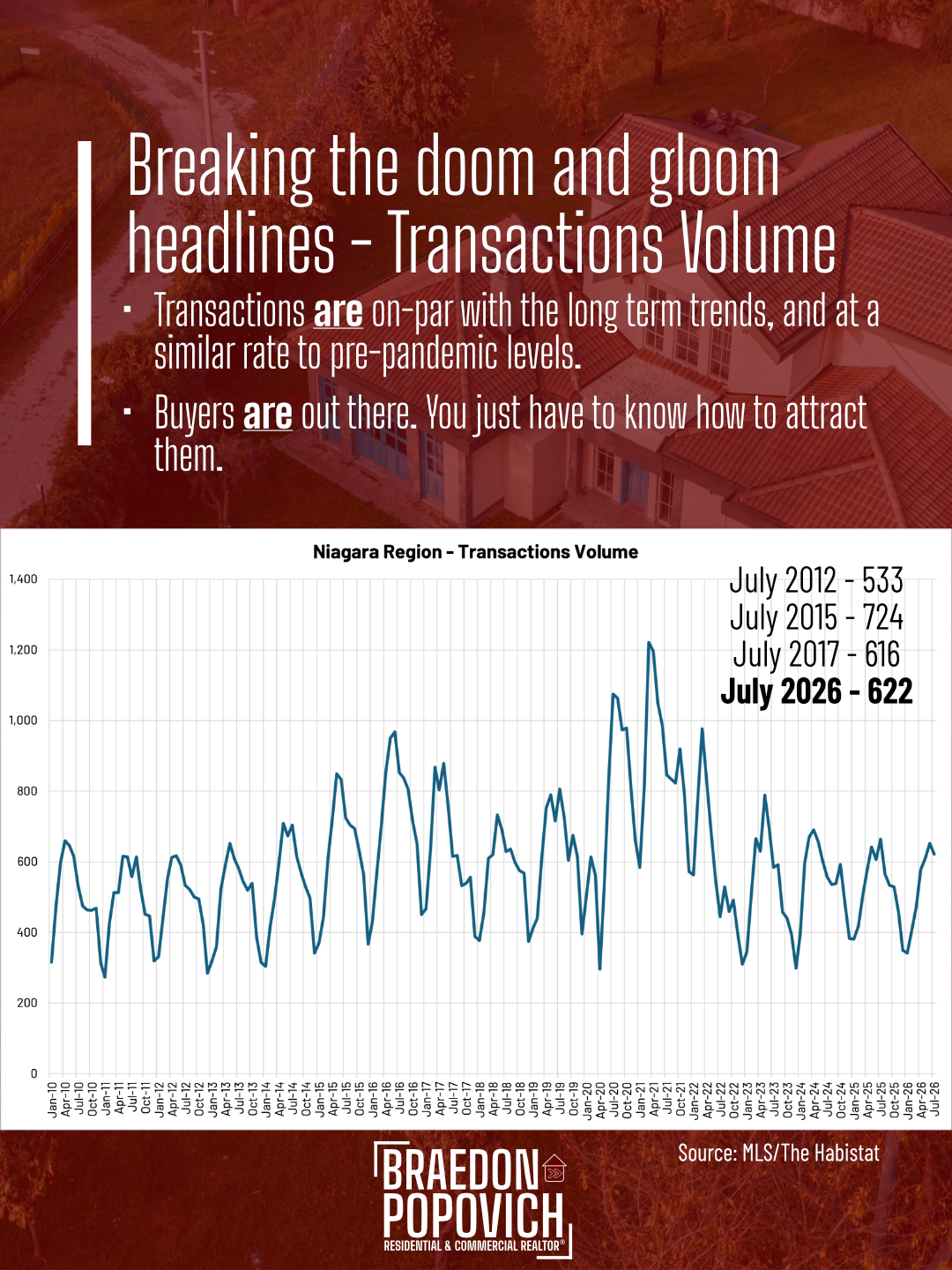
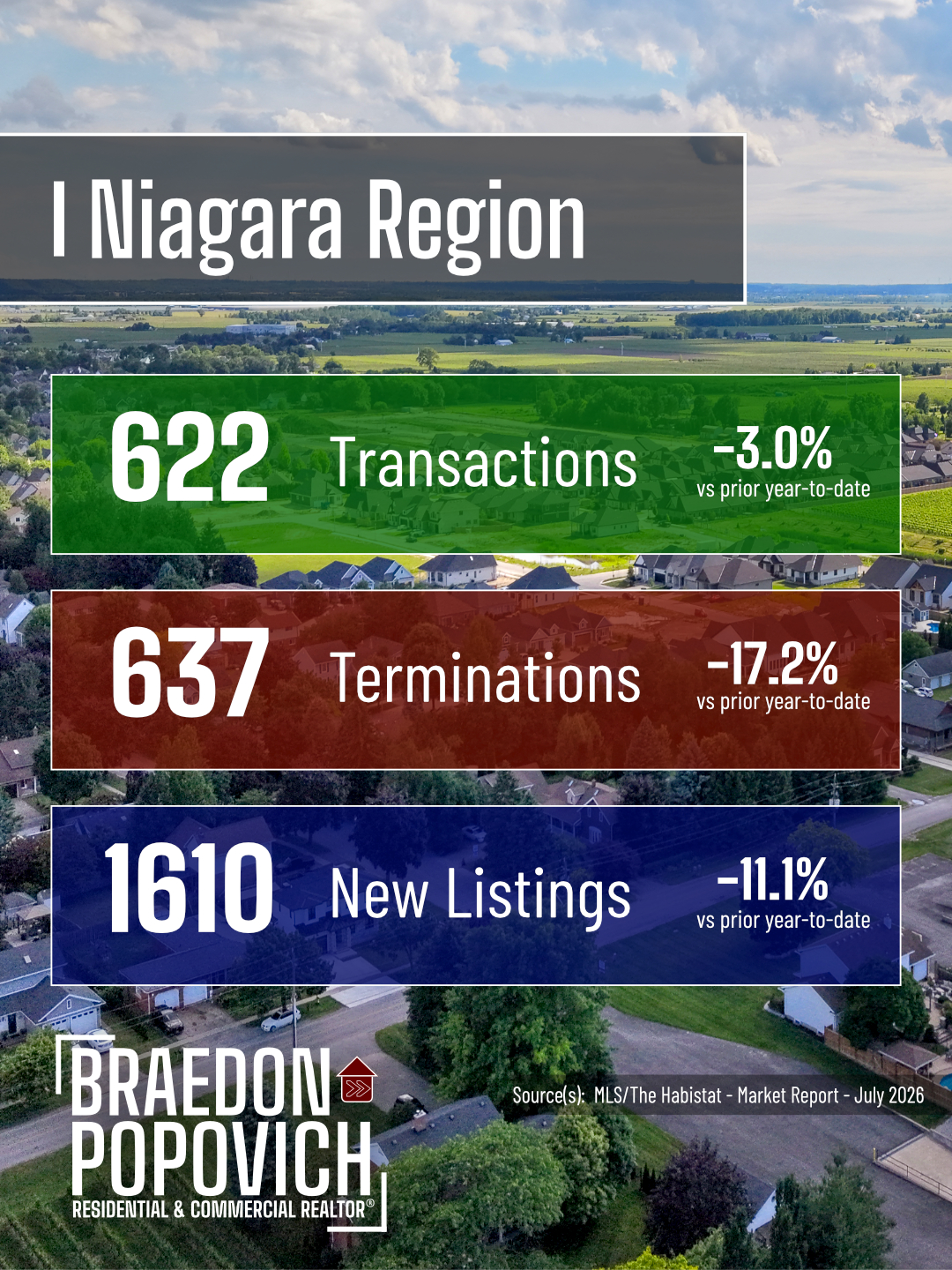
Niagara’s 2026 numbers year-to-date tell a more balanced story than the usual doom-and-gloom headline. There were 622 residential transactions across the region. Year to date, that is down 3.0% from the same point last year—but one month in isolation misses the larger context.

July 2012 recorded 533 sales, July 2015 recorded 724, and July 2017 recorded 616. In other words, July 2026 landed almost exactly on the 2017 level and within the broad range Niagara experienced before the pandemic. It was not a boom month, but it was not an abnormal collapse either.

Prices: below the peak, but not back to the old Niagara market

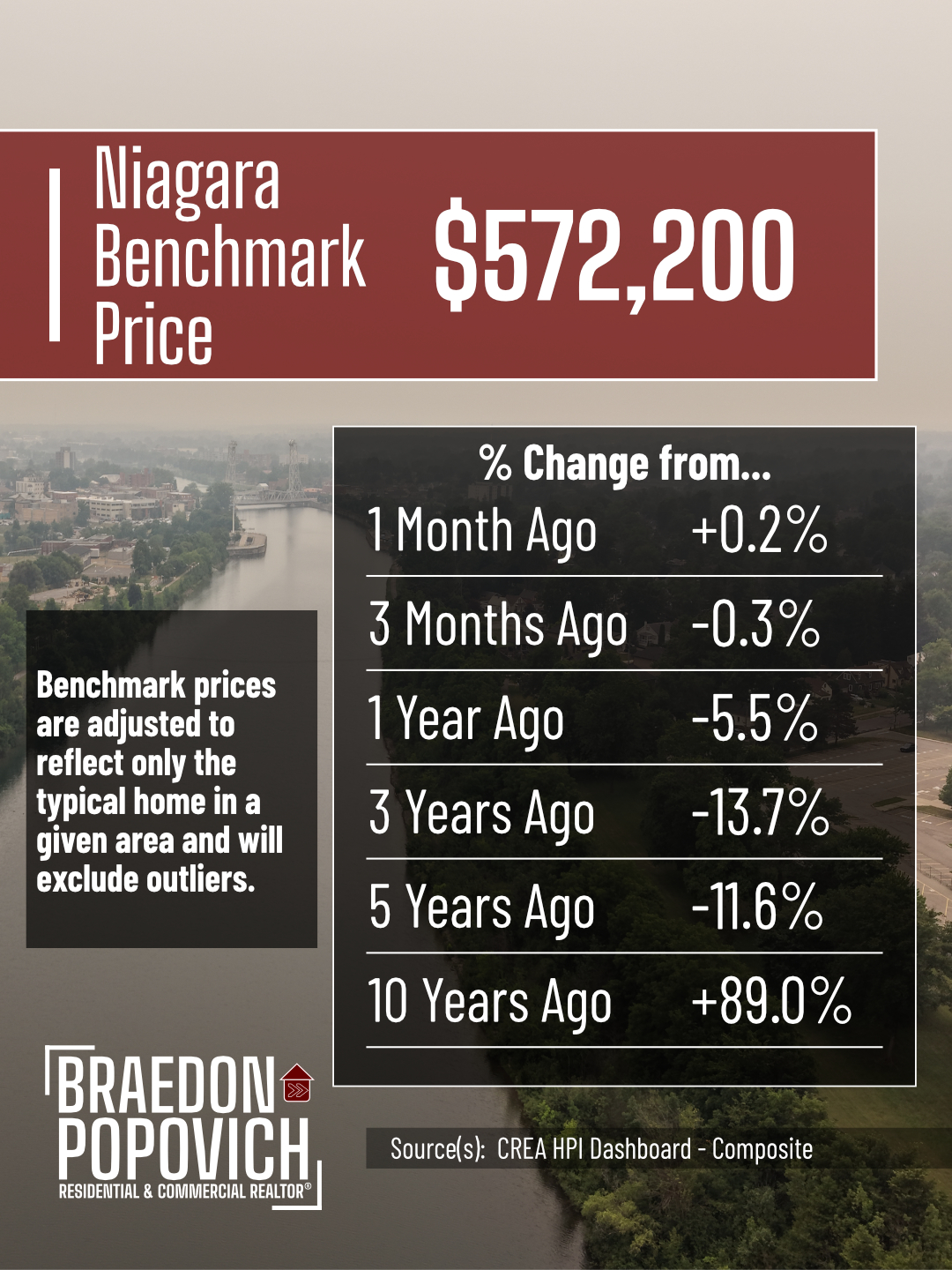
The Niagara composite benchmark price was $572,200 in July. Benchmark pricing is designed to track the value of a typical home while adjusting for differences in the mix of properties sold, so it is more useful for trend analysis than a simple average.

The benchmark increased 0.2% from one month earlier and was down only 0.3% over three months, which points to short-term stabilization. Compared with one year ago, however, it was down 5.5%. It also remained 13.7% below its level three years earlier and 11.6% below five years earlier.

The correction matters, especially to owners who purchased near the peak. But it needs perspective: the benchmark remained 89.0% higher than it was ten years ago. Niagara has given back part of its pandemic-era surge (the inevitable correction). It has not erased a decade of appreciation. And the worst of the correction appears to be over, given the stabilization in prices.

Local prices vary by municipality, as always

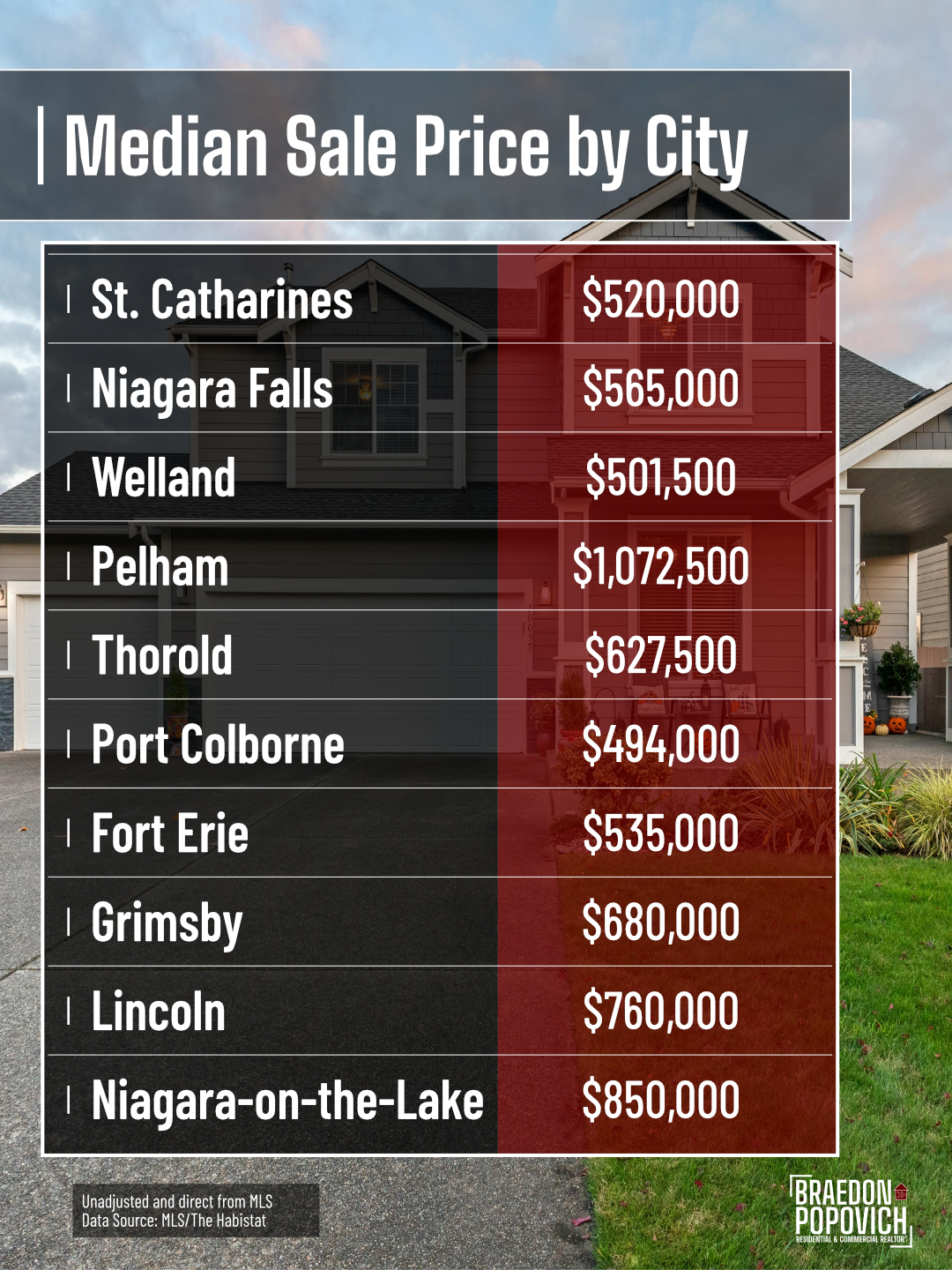
A single Niagara-wide number can hide major differences between communities. July’s unadjusted median sale prices vary between municipalities as always.

These are unadjusted medians, not apples-to-apples measures of identical homes. A municipality with more luxury or rural sales in a given month can jump sharply, while a smaller sample can produce volatility.

The practical lesson is simple: a regional headline is not a pricing strategy. Sellers need neighbourhood-level comparable sales, and buyers need to evaluate the specific property—not assume every Niagara market behaves the same way.

This remains a buyer-friendly market

July had 3,726 active listings, equal to roughly 6.1 months of inventory. The sales-to-new-listings ratio was 38.6%. Those figures favour buyers: there is more selection, properties take longer to sell, and there is usually room for due diligence and negotiation.

The median listing took 29.5 days to sell, and the average sale-to-list-price ratio was 96.2%. That does not mean every buyer should automatically offer 3.8% below asking. Some homes are deliberately underpriced, while others are already well aligned with recent sales. It does mean list price is not the same thing as market value, and strategy matters more than a generic discount.

For buyers who were shut out during the bidding war years, the present market offers something valuable: time. Conditions on financing, inspection, insurance and the sale of an existing home are more realistic on many properties. The trade-off is that financing costs and the mortgage stress test still limit affordability, so a lower purchase price does not automatically make every monthly payment comfortable.

For sellers, preparation and pricing are doing the heavy lifting

A slower market is not an impossible market. It is an unforgiving one. A seller’s first two weeks on the market still matter because that is when the listing is newest and receives the most attention. Starting substantially above the evidence can waste that window and make later price reductions look reactive.

Presentation also matters – it’s not all about the price. Buyers with several comparable options notice deferred maintenance, water concerns, dated finishes and weak marketing. Sellers do not necessarily need a full renovation, but they do need a plan: repair the obvious defects, present the home cleanly, disclose material issues appropriately and price against what has actually sold—not against an aspirational neighbour’s listing.

Construction may improve—but the recovery is not expected immediately

BuildForce Canada expects Ontario residential construction investment to recover significantly toward the end of the decade. Its outlook anticipates additional weakness in new-home demand in the near term, influenced by lower immigration and a surplus of unsold units, before growth returns through new construction in both single-detached and multi-unit housing.

For Niagara, that longer-term recovery could support employment and expand housing supply. It should not be confused with an immediate construction boom. The outlook points to improvement after 2027, while current buyers and sellers are still navigating today’s inventory, interest rates and affordability constraints.

Flooding is now part of the real estate conversation

Following the recent severe flooding across Niagara, property condition and insurance deserve even more attention. Owners should document damage, contact their insurer where appropriate, and check the Niagara Region and their local municipality for available cleanup or support programs.

Buyers should pay close attention to basements, grading, drainage, sump pumps, backwater valves and any evidence of prior water entry. Sellers should not conceal known water damage. A flood event does not automatically make a property unsellable, but poor documentation or an unresolved moisture problem can create much larger issues during inspection, financing and insurance approval.

If you own a Niagara property but are temporarily out of town, arrange for someone to check it. Water damage becomes dramatically more expensive when it sits unnoticed.

Data Sources:

  • MLS/The Habistat, CREA HPI Dashboard, Accessed August 8, 2026
  • https://www.buildforce.ca/en/press-release/buildforce-canadas-construction-and-maintenance-looking-forward-reports-for-2026-to-2035-project-renewed-residential-growth-and-sustained-high-levels-of-non-residential-activity/
  • https://canada.constructconnect.com/dcn/news/economic/2026/07/ontario-construction-outlook-brightens-as-residential-growth-returns-buildforce

Transactions are happening. It’s the “wait-and-see” people who are missing out.
Niagara’s 2026 numbers year-to-date tell a more balanced story than the usual doom-and-gloom headline. There were 622 residential transactions across the region. Year to date, that is down 3.0% from the same point last year—but one month in isolation misses the larger context.

July 2012 recorded 533 sales, July 2015 recorded 724, and July 2017 recorded 616. In other words, July 2026 landed almost exactly on the 2017 level and within the broad range Niagara experienced before the pandemic. It was not a boom month, but it was not an abnormal collapse either.

Prices: below the peak, but not back to the old Niagara market
The Niagara composite benchmark price was $572,200 in July. Benchmark pricing is designed to track the value of a typical home while adjusting for differences in the mix of properties sold, so it is more useful for trend analysis than a simple average.

The benchmark increased 0.2% from one month earlier and was down only 0.3% over three months, which points to short-term stabilization. Compared with one year ago, however, it was down 5.5%. It also remained 13.7% below its level three years earlier and 11.6% below five years earlier.

The correction matters, especially to owners who purchased near the peak. But it needs perspective: the benchmark remained 89.0% higher than it was ten years ago. Niagara has given back part of its pandemic-era surge (the inevitable correction). It has not erased a decade of appreciation. And the worst of the correction appears to be over, given the stabilization in prices.

Local prices vary by municipality, as always

A single Niagara-wide number can hide major differences between communities. July’s unadjusted median sale prices vary between municipalities as always.

These are unadjusted medians, not apples-to-apples measures of identical homes. A municipality with more luxury or rural sales in a given month can jump sharply, while a smaller sample can produce volatility.

The practical lesson is simple: a regional headline is not a pricing strategy. Sellers need neighbourhood-level comparable sales, and buyers need to evaluate the specific property—not assume every Niagara market behaves the same way.

This remains a buyer-friendly market

July had 3,726 active listings, equal to roughly 6.1 months of inventory. The sales-to-new-listings ratio was 38.6%. Those figures favour buyers: there is more selection, properties take longer to sell, and there is usually room for due diligence and negotiation.

The median listing took 29.5 days to sell, and the average sale-to-list-price ratio was 96.2%. That does not mean every buyer should automatically offer 3.8% below asking. Some homes are deliberately underpriced, while others are already well aligned with recent sales. It does mean list price is not the same thing as market value, and strategy matters more than a generic discount.
For buyers who were shut out during the bidding war years, the present market offers something valuable: time. Conditions on financing, inspection, insurance and the sale of an existing home are more realistic on many properties. The trade-off is that financing costs and the mortgage stress test still limit affordability, so a lower purchase price does not automatically make every monthly payment comfortable.

For sellers, preparation and pricing are doing the heavy lifting

A slower market is not an impossible market. It is an unforgiving one. A seller’s first two weeks on the market still matter because that is when the listing is newest and receives the most attention. Starting substantially above the evidence can waste that window and make later price reductions look reactive.

Presentation also matters – it’s not all about the price. Buyers with several comparable options notice deferred maintenance, water concerns, dated finishes and weak marketing. Sellers do not necessarily need a full renovation, but they do need a plan: repair the obvious defects, present the home cleanly, disclose material issues appropriately and price against what has actually sold—not against an aspirational neighbour’s listing.

Construction may improve—but the recovery is not expected immediately
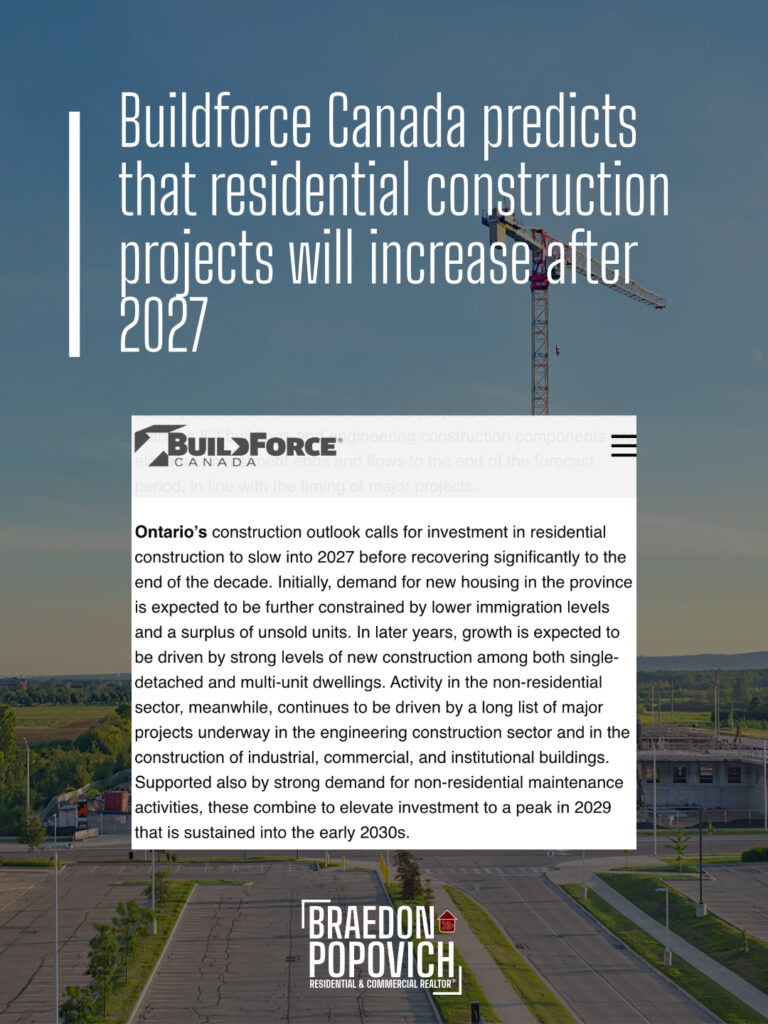
BuildForce Canada expects Ontario residential construction investment to recover significantly toward the end of the decade. Its outlook anticipates additional weakness in new-home demand in the near term, influenced by lower immigration and a surplus of unsold units, before growth returns through new construction in both single-detached and multi-unit housing.

For Niagara, that longer-term recovery could support employment and expand housing supply. It should not be confused with an immediate construction boom. The outlook points to improvement after 2027, while current buyers and sellers are still navigating today’s inventory, interest rates and affordability constraints.

Flooding is now part of the real estate conversation

Following the recent severe flooding across Niagara, property condition and insurance deserve even more attention. Owners should document damage, contact their insurer where appropriate, and check the Niagara Region and their local municipality for available cleanup or support programs.

Buyers should pay close attention to basements, grading, drainage, sump pumps, backwater valves and any evidence of prior water entry. Sellers should not conceal known water damage. A flood event does not automatically make a property unsellable, but poor documentation or an unresolved moisture problem can create much larger issues during inspection, financing and insurance approval.

If you own a Niagara property but are temporarily out of town, arrange for someone to check it. Water damage becomes dramatically more expensive when it sits unnoticed.

Data Sources:

  • MLS/The Habistat, CREA HPI Dashboard, Accessed August 8, 2026
  • https://www.buildforce.ca/en/press-release/buildforce-canadas-construction-and-maintenance-looking-forward-reports-for-2026-to-2035-project-renewed-residential-growth-and-sustained-high-levels-of-non-residential-activity/
  • https://canada.constructconnect.com/dcn/news/economic/2026/07/ontario-construction-outlook-brightens-as-residential-growth-returns-buildforce

Hey Niagara!
Need real estate advice?

Fill out this form and let’s get it touch!